
In early 2025 a South African regional court president sent us a message that should have had an easy answer. A charge sheet in one of her regional courts cited a statute that had been repealed. The same charge sheet had already served in a district court, where the accused was granted bail on it. Her prosecutor did not know of the later Act that was believed to apply. In a separate matter that same week, a state advocate insisted from the bar that the later Act was in operation. Nobody in the chain could say which law was in force, not the prosecution, not the defence, not the bench. It took our team weeks in gazette archives to establish that the later Act had never commenced at all. On 28 October 2026 a foundation in the United States offered USD 10,000 to anyone who could settle a related question about Nigerian law. Two countries, two legal systems, both served by long-established commercial legal publishers, and in both the same question went unanswered: what law was in force on the day of the judgment?
An Act that never began
The Explosives Act 15 of 2003 has never come into operation. Twenty-three years after Parliament passed it, the law it was meant to replace, the Explosives Act 26 of 1956, is still the governing statute in South Africa.
What we were asked to do was resolve a disagreement inside the judiciary. A lower court held that the Act had not commenced. A higher court held that it had. Neither was being careless. They were reading different sources, and the sources disagreed with each other.
The mechanism is unremarkable. Section 13(1) of the Interpretation Act 33 of 1957 provides that a law commences on the day it is first published in the Gazette, unless some other day is fixed by or under that law. Section 35 of the 2003 Act fixes another day: it comes into operation on a date set by the President by proclamation. No such proclamation was ever issued. We searched the Sabinet Legal and Johannesburg Bar Library gazette collections, digital and paper, across the full period from 2003, and found none.
The consequences run further than the Act itself. Schedule 1 of the 2003 Act repeals the Explosives Act 26 of 1956 and thirteen of its amendment Acts, and provides for amendments to the Riotous Assemblies Act 17 of 1956. Because the Schedule forms part of an Act that never commenced, none of this took legal effect: the 1956 Act and its amendments remain in force, and the amendments to the Riotous Assemblies Act are inoperative. Meanwhile, the 2003 Act was itself amended three times, by the Criminal Law (Sexual Offences and Related Matters) Amendment Act 2007 and the Criminal Law (Forensic Procedures) Amendment Acts of 2010 and 2013, taking effect in December 2007, January 2013 and January 2015. A statute diligently maintained in the law books while having no operation in law.
What made the problem invisible is that the available sources did not agree, and none of them showed its work:
| Source | What it recorded | Basis given |
|---|---|---|
| Gov.za (at March 2025) | Commenced 8 January 2004 | None. This is the Gazette publication date, not a commencement date |
| Sabinet Legal landing page | Commenced 3 March 2023 | None; no proclamation or Gazette cited. Sabinet later confirmed the date was entered in error and corrected the page |
| Sabinet Legal PDF of the Act | To be proclaimed | not applicable |
| LexisNexis | To be proclaimed | not applicable |
| Jutastat | To be proclaimed | not applicable |
Four sources, three answers, no citations. A practitioner consulting any one of them in good faith could be badly wrong, and would have no way of knowing it.
The cost landed in criminal courts, and not as a citation slip.
In Fourie and Others v S (A257/2023) [2024] ZAGPPHC 2713 [LawLibrary] (6 December 2024), an appeal arising from a cash-in-transit robbery, count 2 was a contravention of section 22(2) of the Explosives Act. A full bench dismissed the appeal against that conviction and sentenced each appellant to ten years' imprisonment on it, five years running concurrently, within an effective 25 years ante-dated to July 2022. In S v Mbuyani (CC64/20) [2023] ZAGPPHC 1785 [LawLibrary] (26 May 2023), on the same provision, the court granted leave to appeal on the firearms counts and on sentence but refused it on "the contravention of section 22(2) of the Explosives Act 15 of 2003". In Motikeng v Moni and Another (8853/21) [2022] ZAWCHC 245 [LawLibrary] (15 December 2022), two accused stood trial in the Beaufort West Regional Court on a charge under the 2003 Act after pipe bombs and detonators were found in their vehicle. That trial ran from August 2020 and reached the High Court on review in December 2022 without anyone asking whether the Act was in force.
The fourth should be read closely, because it runs the other way. In M A M v S (Order) (A102/2024) [2024] ZAGPJHC 2693 [LawLibrary] (17 September 2024) the appellant was charged with unlawful possession of a plastic hand grenade under section 28 of the Explosives Act 26 of 1956, which is correct, because the 1956 Act is the law in force. At paragraph 2 the judgment volunteers that it is important to note that the 1956 Act has been repealed and replaced by the Explosives Act 15 of 2003. It has not. At paragraph 21 the State argued that the appellant, as a first offender, faced a further fifteen years under section 29(1)(d) of the 2003 Act. At paragraph 33 the court expressly incorporated that argument into its reasoning and refused bail. One of the statutory factors is the nature and gravity of the punishment likely to be imposed on conviction.
A man was therefore kept in custody partly on the strength of a sentencing exposure under a statute that does not exist in law, in a judgment that took a correct charge and recorded it as superseded.
Working backwards from a single charge sheet, the error runs through charge formulation, bail, argument from the bar, conviction, sentence and appeal. Nobody in these four cases was careless. The Act sat in the statute books. It had been amended three times. Commercial databases carried it. The government's own website recorded it as commenced. Every participant was doing their job competently against sources that were wrong.
We delivered our report on 7 March 2025. It was circulated to some judges, it was put to the National Prosecuting Authority, and it raised the obvious and uncomfortable question of whether sentences imposed on the wrong statutory basis must now be revisited. Gov.za has since been corrected: the Explosives Act page now records commencement as "To be proclaimed". That is the right outcome, and it is worth being precise about how it was reached. Not by any systemic control, but because one judge noticed an anomaly, asked a non-profit, and a small editorial team spent weeks in gazette archives.
Our analysis of the knock-on effects is not final. The Riotous Assemblies Act has an amendment history of its own, with roughly ten later amending Acts still to be processed, and until that work is done we are not asserting a settled conclusion about its current operative text. What we can say is that the amendments the 2003 Act provided for never took effect, because the Act carrying them never commenced. Marking the boundary of what is known is itself part of legal authority, and it is exactly what the sources that offered us three different commencement dates failed to do.
A bounty on a legal question
On 28 October 2026 SaharaReporters reported that the Rising Sun Foundation USA had offered USD 10,000 to anyone who could produce a verifiable Nigerian precedent upholding a criminal conviction founded on a statute repealed before judgment was delivered. The challenge was addressed to Justice James Omotosho of the Federal High Court and, beyond him, to Nigeria's lawyers, academics and legal institutions. It concerns the conviction of Nnamdi Kanu on seven counts on 20 November 2025.
I take no position on that appeal. It is live, it is politically charged, and its merits are not my subject. The shape of the dispute is.
The question is whether the Terrorism (Prevention) (Amendment) Act 2013 could lawfully ground the conviction, given that the Terrorism (Prevention and Prohibition) Act 2022 repealed the 2011 Act which the 2013 Act amended. The answer turns on two provisions of the 2022 Act: section 97, headed "Savings and Transitional Provision", and section 98, headed "Repeal of the Terrorism (Prevention) Act, 2011".
So we went to read them, and that is where this becomes a story about infrastructure. The 2022 Act was published in Official Gazette No. 91, Volume 109, of 16 May 2022, Government Notice No. 68, an extraordinary issue, at pages A489–574. We could not obtain that gazette from any Nigerian government website. We read it from Gazettes.Africa, the archive our own organisation maintains. A Cape Town non-profit is, as far as we can establish, among the few places where the operative text of a Nigerian statute carrying life sentences can be read free of charge.
Having read it, here is what those provisions actually say. What follows is the full text of sections 97 and 98 of the Terrorism (Prevention and Prohibition) Act 2022, headed “Savings and Transitional Provision” and “Repeal of the Terrorism (Prevention) Act, 2011” respectively, as published in Official Gazette No. 91, Volume 109 of 16 May 2022. It is worth setting out in full, because much of the public argument has been conducted on paraphrase.
97. Any regulation, order, requirement, certificate, notice, direction, decision, authorisation, consent, application, ongoing cases in the courts, request, or thing made, issued, given or done under the repealed Acts or amended sections shall, if in force at the commencement of this Act, continue to be in force and have effect as if made, issued, given or done under the corresponding provisions of this Act.
98.—(1) The Terrorism (Prevention) Act, No. 10, 2011 is repealed.
(2) Any regulation, order, requirement, certificate, notice, direction, decision, authorisation, consent, application, ongoing cases in the courts, request or thing made, issued, given or done under the repealed Acts shall, if in force at the commencement of this Act, continue to be in force and have effect as if made, issued, given or done under the corresponding provisions of this Act.
(3) Any proceeding, prosecution, sentence, judgment, charge or cause of action pending or existing immediately before the commencement of this Act under any of the repealed Act in respect of any right, interest, obligation or liability, may be continued or commenced, as the case may be, and any determination of a court of law, tribunal or other authorities or person may be enforced to the same extent that such proceeding, prosecution, sentence, judgment, charge, cause of action or determination might have been continued, commenced or enforced as if this Act had not been made.
Four things are apparent on the face of the text, and I state them as observations rather than conclusions.
The 2013 Amendment Act is never named. Section 98(1) repeals the Terrorism (Prevention) Act No. 10 of 2011 and nothing else by name. The long title, the explanatory memorandum and the bill schedule likewise name only the 2011 Act. The 2013 Amendment Act does not appear anywhere in the Act.
Yet the savings provisions assume there were several. Section 97 refers to "the repealed Acts or amended sections", section 98(2) to "the repealed Acts", and section 98(3) to "any of the repealed Act". Plural throughout, against a repeal clause that identifies one statute. The phrase "or amended sections" in section 97 is the Act's only oblique acknowledgement that an amending Act exists.
Sections 97 and 98(2) are near-verbatim duplicates. The same list of instruments, the same conditional, the same effect, enacted twice within three subsections of each other.
And the two limbs point in different directions. Sections 97 and 98(2) are mandatory in form: things done under the repealed law "shall ... continue to be in force and have effect as if made ... under the corresponding provisions of this Act". Section 98(3) is permissive: proceedings "may be continued or commenced" and determinations enforced "as if this Act had not been made". One directs continuation under the new Act; the other preserves the position under the old. Both are in the same statute, three lines apart.
One date anchors all of it. The 2022 Act carries a commencement note of 12 May 2022 and takes effect on assent, with no deferred proclamation, so unlike the South African case, there is no mystery about whether it is in force. Everything therefore turns on what was "pending or existing immediately before" that day, and under which instrument.
The trial court relied on section 98(3). Those challenging the conviction rely on section 97. Having now read both, I can see why: the Act gives each side a provision, and I do not propose to resolve on a blog what is before the Court of Appeal.
What I will say is that this ambiguity was discoverable from the day the Act was gazetted. It is visible on a careful reading of three paragraphs. It did not require an appeal, an advocacy campaign or a reward to surface it. It required somebody to read the gazette, and for three and a half years that meant knowing where a privately maintained archive kept a copy.
That is the compounding failure. A drafting ambiguity is ordinary; legislatures produce them constantly, and legal systems have mechanisms for resolving them. What turns an ordinary ambiguity into a public controversy with a bounty attached is that the text was not where anyone could check it. Had the 2022 Act been published openly on commencement and maintained as structured data, with its repeal of the 2011 Act recorded as a dated event, and the consequential position of the 2013 Amendment Act made explicit rather than left to inference, the question would have been argued in 2022, by lawyers, on the text. Instead it is being argued in 2026, in the press, over a conviction.
A bounty is not a legal argument. It is a symptom. Where the authoritative text is not publicly available, what the law says stops being a matter of record and becomes a matter of contest, settled by whoever asserts most confidently or pays most.
Nor is this peculiar to terrorism legislation. The Nigerian public record has been documented as deficient by Nigeria's own institutions:
| Date | What the record shows |
|---|---|
| January 2026 | The National Assembly issues a statement responding to public concern over alleged discrepancies between its Votes and Proceedings and the gazetted versions of recently passed Tax Acts, and directs the release of transmitted bills with presidential assent pages so the public can verify them |
| October 2024 | The Attorney-General inaugurates a committee, chaired by Olawale Fapohunda SAN, to review and consolidate the Laws of the Federation from 2004 onward, with six months to report. Two years on, we found no published new edition |
| July 2023 | The House of Representatives resolves that no official government website publishes every law enacted by the National Assembly and assented to, and that the Constitution has been amended five times with no official consolidated version, making it hard for citizens and investors to establish the applicable law |
| 2004 | The last official revised edition of the Laws of the Federation is published, consolidating federal laws in force as at 31 December 2002 |
Read that table from the bottom up. The consolidated statute book is almost twenty-four years out of date. The legislature has said so on the record. A revision committee was appointed and we cannot establish that it has reported. And by January 2026 the gap had reached the point where the text of tax statutes was publicly disputed and verification required applying for a certified copy.
This is an infrastructure failure, not a competence failure
First, a framing point, because the obvious misreading of this piece is the wrong one. This is not an African data problem. South Africa has an independent judiciary, official government sources, established commercial publishers and extensive digital legal information, and it produced this failure anyway. The problem is legal status, time, and systems that do not speak to one another. Documents can look complete while concealing a failure in the legal system itself. Any jurisdiction that commences statutes by proclamation is exposed to it, and most do.
It is tempting to read these stories as carelessness: counsel who did not check, judges who did not notice. That reading is comfortable and wrong. The judges and practitioners involved were consulting the sources available to them. The sources were silent, incomplete or contradictory.
A statute is not a document. It is a document plus a history of dated events, each one authorised by a separate instrument: the Act is assented to, published, brought into force in whole or in part on a date fixed by proclamation, amended by later Acts, partly repealed, wholly repealed. Every one of those events is recorded somewhere in a gazette. None of them is visible in the text of the Act itself.
So the question "what law was in force on the day of the judgment?" cannot be answered by reading a PDF. A collection of documents is not yet a legal database. The question can only be answered by a system that holds three things together:
- Point-in-time text. The consolidated wording as it stood on a given date, not merely the latest version and not merely the text as enacted.
- A commencement and amendment record. Each change expressed as a dated event with its own identity, including the negative case: an Act that has not commenced, or a provision brought into force while the rest of the Act was not.
- Provenance for each event. A citation to the gazette notice or proclamation that effected it, so a user can verify the claim rather than trust the publisher.
The third is the one everybody skips, and it is the one that would have prevented both failures. Gov.za asserted a commencement date for the Explosives Act. Sabinet asserted a different one. Neither showed a proclamation, because neither existed. Had either been required to display its source, the error would have been visible the moment it was made.
This is why Laws.Africa publishes legislation in Akoma Ntoso, the XML standard for legislative, regulatory and judicial documents approved by OASIS in August 2018, with FRBR-style identifiers that address a work, a specific language version, and a version as at a given date. It is not a technical preference. It is the only practical way to make commencement, amendment and repeal first-class, dated, citable data rather than a line of editorial prose that may or may not be right.
Judgments are the other half of the record
Everything above concerns legislation. The second half of the problem is case law, and the Explosives Act story shows why the two cannot be separated.
We know that four courts applied an uncommenced statute only because those four judgments were published. Had they sat in registry files, the error would have been undiscoverable. Not difficult. Undiscoverable. The ability to audit how courts actually apply the law is a direct function of whether judgments are public, complete and searchable. A jurisdiction that publishes selected judgments publishes a selected view of its own performance.
This matters more now than it did five years ago, for a reason that has nothing to do with judicial standards. Legal research is being done through AI systems, in Africa as everywhere else. Those systems do not know what is authoritative; they know what is reachable. Where the reachable corpus is partial, out of date or silent on commencement, the output will be fluent and wrong, and it will be wrong at a volume no editorial team can check. A paper published through the South African judiciary's J20 platform makes the point from the bench's side: incomplete or inaccurate records undermine both AI tools and ordinary case-law searches, and models trained on foreign data import assumptions that do not hold locally. The current engineering shorthand is a PDF and a retrieval layer over it, and that is not sufficient. What these systems need is per-provision structure: dates of effect, commencement status, and amendment history attached to the provision itself rather than narrated in a preface the retriever will never surface.
South African courts have been working through the consequences since 2023. In Parker v Forsyth NNO and Others (1585/20) [2023] ZAGPRD 1 [LawLibrary] (29 June 2023), attorneys sourced authorities from ChatGPT and admitted they had neither accessed nor read them; the court found carelessness rather than any attempt to mislead, and made no referral. By January 2025, in Mavundla v MEC: Department of Co-Operative Government and Traditional Affairs KwaZulu-Natal and Others (7940/2024P) [2025] ZAKZPHC 115 [LawLibrary] (8 January 2025) (Leave to Appeal), nine authorities were cited and the court's researchers established that only two existed. Bezuidenhout J ordered the firm to pay the costs of two additional appearances de bonis propriis and referred the judgment to the Legal Practice Council. In Northbound Processing (Pty) Ltd v South African Diamond and Precious Metals Regulator and Others (2025-072038) [2025] ZAGPJHC 1990 [LawLibrary] (30 June 2025), counsel confirmed that the fabricated citations had come from a subscription product marketed as trained exclusively on South African judgments and legislation.
That last detail disposes of the comfortable reading that this is about lawyers playing with consumer chatbots. A tool sold as domain-specific produced fabricated South African authorities, in a market where the authoritative corpus it would need to be trained on, or checked against, is not freely and completely available.
The Mavundla record also contains the sharpest statement of the underlying problem, and it came from the practitioners themselves: the firm told the court it had no access to the South African Law Reports or the All South African Law Reports. The fabrication filled a gap that paywalled case law had left open. That is the infrastructure argument, made on the record, in a courtroom.
It has now reached the decision-makers. In South African Post Office SOC Ltd and Others v Fakude NO and Others (2026 – 249228) [2026] ZALCJHB 579 [LawLibrary] (23 October 2026), the Labour Court in Johannesburg stayed a CCMA arbitration after finding that the arbitrator had relied in part on a Constitutional Court judgment that does not exist, which the court held to be a material irregularity and misconduct. Three months earlier, in Molawa and Others v Matjhabeng Local Municipality and Another (2026-157576) [2026] ZALCD 63 [LawLibrary] (13 July 2026), the Labour Court in Durban stayed a disciplinary hearing on finding prima facie that the chairperson had relied on authorities that either did not exist or did not support the propositions he drew from them. These are no longer lawyers embarrassing themselves in front of a judge. They are findings being made on authorities that were never written.
Now set against that what a search for equivalent Nigerian material returns: nothing. We could not locate a single reported Nigerian judgment in which a court addressed counsel citing fabricated or AI-generated authorities, nor any disciplinary action by the National Judicial Council, the Body of Benchers or the Bar Association on those facts. A serving Nigerian High Court judge who has written on the subject cites no Nigerian case at all; his worked example is American.
The honest reading of that absence is not that it has not happened. It is that Nigeria has no free, comprehensive judgment database, so decisions are largely invisible unless a commercial publisher chooses to report them. South Africa can see its problem because South Africa publishes its judgments. Nigeria's silence is not a clean bill of health. It is what happens when nobody can look.
The usual response is to regulate the lawyer: practice notes on verifying AI output, CPD on professional responsibility. That is necessary, but not sufficient. Telling practitioners to verify against an authoritative source presupposes that one exists. In the Explosives Act case, a diligent lawyer who verified against gov.za in March 2025 would have been confirmed in the wrong answer. Verification duties without verifiable sources shift the blame without reducing the error.
So the case-law asks are the same in shape as the legislation asks: publish everything, publish promptly, publish free, publish in bulk and in a machine-readable form, and attach stable citations so a reference can be checked rather than merely asserted.
Why the market does not close this gap
The usual answer is that the market already supplies it. South Africa has Juta, LexisNexis and Sabinet. Nigeria has LawPavilion, Legalpedia and Primsol. These are capable businesses employing skilled legal editors, and this piece is not an argument against them.
It is an argument that they cannot be the system of record, for four structural reasons.
They owe no duty of completeness. A commercial publisher's obligation runs to its subscribers under a contract, not to the public under a constitution. When Sabinet carried an incorrect commencement date for the Explosives Act, no legal consequence followed, and none should have, because it is a private company publishing a private database. But that is precisely the point: there was no one whose job it was to be right.
The commercial incentive points away from the hard cases. The revenue in legal publishing is in the law people use. An Act that never commenced generates no searches, no alerts and no renewals. Uncommenced provisions, partial commencements, repeals that never took effect, and colonial-era statutes that technically survive are exactly the material a subscription market under-serves and exactly the material that produces wrongful convictions.
A paywall suppresses error correction. Our 2025 report exists because gazettes and judgments were open enough for a small team to audit them. In a closed system, the four judgments applying an uncommenced Act are invisible to everyone outside the subscriber base, and the error compounds quietly. Open data is not only an access policy; it is a quality-control mechanism.
Their corrections bind nobody. When a publisher fixes a date, nothing downstream changes. Judgments already delivered on the old understanding stand. There is no authoritative record against which a court, a prosecutor or a defence lawyer can check and be entitled to rely on what they find.
Both South Africa and Nigeria have commercial publishers. Both produced these failures anyway. That is the empirical answer to the claim that procurement can substitute for public infrastructure.
The deeper reason is constitutional rather than commercial. A state that enacts law binding on people owes them the ability to know what that law is. In South Africa that follows from the rule-of-law foundation in section 1(c) of the Constitution; in Nigeria, section 36(12) makes it concrete by requiring that an offence be clearly defined, and its penalty prescribed, in a written law. You cannot operate a principle of legality on top of a database nobody is accountable for. Publishing the law is not a service government may outsource at its convenience. It is part of what it means to have made the law at all.
What authoritative looks like
None of this requires invention. The material already exists: every state in question publishes its gazettes. What is missing is the layer that turns scattered notices into a record a court can rely on.
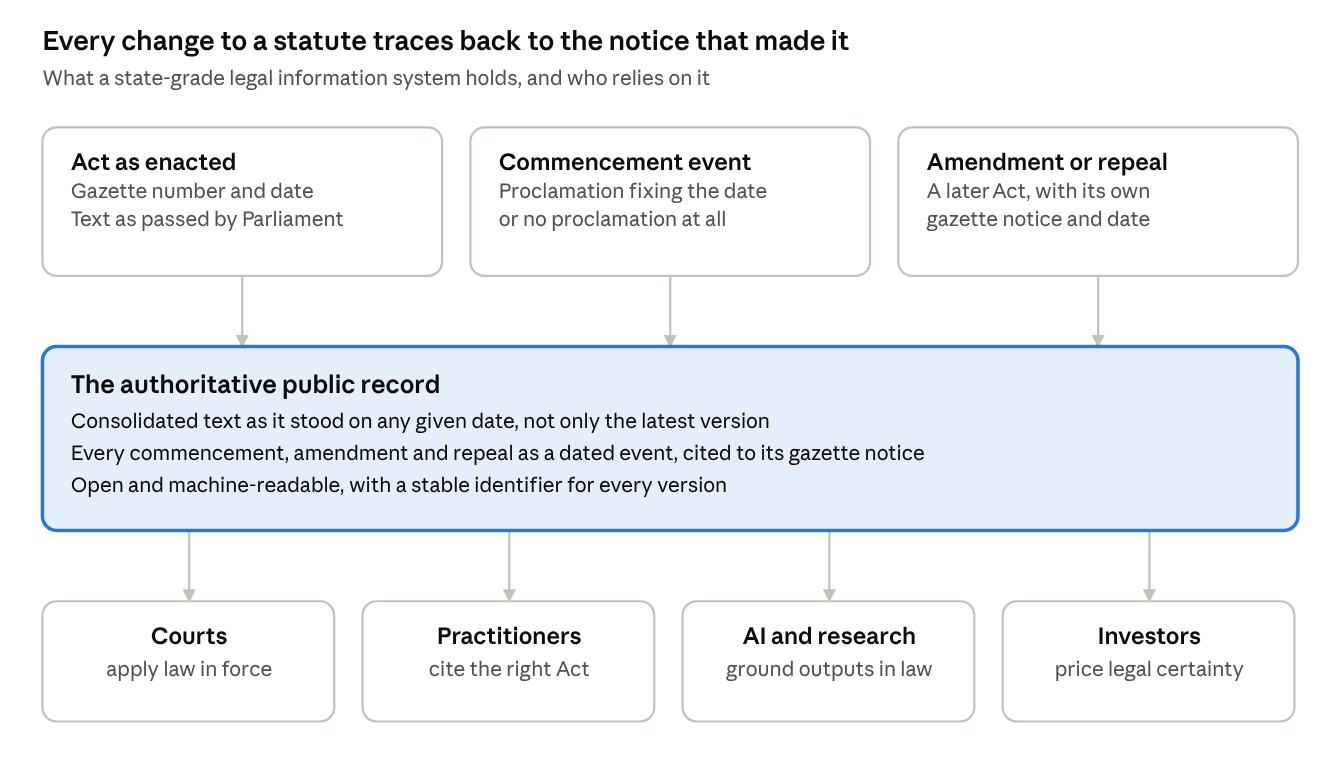
Figure: every change to a statute traces back to the notice that made it.
The middle band is the part no African jurisdiction can buy and few currently maintain. Note the second box in the top row: the Explosives Act failed there, in the negative case. A system that only records commencements it finds will quietly show nothing where a proclamation is absent, and a user will read that silence as "in force".
Three working examples, none of them exotic:
| Jurisdiction | Who runs it | What it does that matters here |
|---|---|---|
| New Zealand | Parliamentary Counsel Office, under the Legislation Act 2019 | Labels every item in force, not yet in force, repealed or revoked; flags amendments passed but not yet commenced; since 2025 publishes commencement tables with specific dates |
| United Kingdom | The National Archives, for HM Government | Maintains revised consolidated versions under the authority of the Controller of HMSO, with an editorial team responsible for applying effects |
| Kenya | National Council for Law Reporting, chaired by the Chief Justice | A statutory body mandated to revise, consolidate and publish the Laws of Kenya, and to report the jurisprudence, free to the public |
Kenya is the one to sit with. It is not a wealthy jurisdiction and it did not wait for one. It created a public body, gave it a statutory mandate covering both legislation and law reporting, placed the head of the judiciary at the top of it, and funded it. The result is that a Kenyan judge, a Kenyan investor and a Kenyan citizen consult the same authoritative text, free. The constraint elsewhere has never been money or technology. It has been that nobody was made responsible.
What we are asking for
Start with the data, not the audit.
The ask is not that someone commission a review. It is the data work that makes the review automatic. Finding the Explosives Act took us weeks in gazette archives. That is what it costs when the record is a pile of documents. It is not what it should cost, and it is not what it costs now.
Once legislation is held as structured data, with every commencement, amendment and repeal recorded as a dated event linked to the gazette notice that effected it, and once the gazettes themselves are scanned and indexed, a list of Acts that have never commenced is a query rather than a project. It can be exported, published, and re-run every time the statute book changes.
That capability already exists. Filtering the South African collection on LawLibrary to Acts recorded as not yet commenced returns 56 results today, national and provincial, among them the Explosives Act 15 of 2003. Not one Act in that collection is marked “commencement unknown”, which matters as much as the 56 does: the status has been determined for every Act rather than left silent, and silence is what let the Explosives Act sit unnoticed for twenty-two years. None of this is possible without the gazettes, which is why we have spent years scanning them. South African coverage is now roughly 95 per cent complete.
So the ask of a Ministry of Justice is not for a one-off exercise. It is this: hold your statute book as data, link it to a complete gazette archive, and the audit stops being a project and becomes a report you can run on demand. South Africa’s uncommenced Acts surfaced because one judge noticed an anomaly in one subject area. No jurisdiction should have to rely on that.
A fuller version of the same test is four questions that any legal information system ought to be able to answer. If yours cannot, what you have is a document collection, not a legal database.
- Which Acts or provisions have been enacted but never commenced?
- Which apparent amendments and repeals have not taken legal effect?
- Where do authoritative sources disagree about what is in force?
- Which judgments rely on legal material whose status was different at the relevant time?
Beyond that, the asks differ by who is reading.
Ministries of Justice and Attorneys-General. Name one body, in legislation, that is accountable for publishing the consolidated statute book and its commencement record, and fund it on the recurrent budget rather than as a donor project. The Kenyan model is available and has been running for three decades. The question to put to your own system is simple: if a court applies a repealed or uncommenced provision tomorrow, whose job was it to prevent that? If the answer is nobody, that is the finding.
Law revision commissions and Chief Parliamentary Draftsmen. Publish commencement as data, not prose. One record per commencement event, carrying the gazette number, the date, and the provisions brought into force. Publish the negative case with the same prominence as the positive one. Adopt an open standard. Akoma Ntoso exists, is in use across the continent, and spares you building a format of your own.
Judiciaries. Publish every judgment, promptly, free, in bulk and under an open licence. Our four South African examples were only findable because the judgments were public. Consider a practice direction requiring counsel to state the version and date of the statute relied on. It costs nothing and it moves verification to the point where it is cheapest.
Bars and law societies. Treat statutory-status verification as a competence requirement, not a courtesy. It belongs in CPD alongside the AI-use guidance now being drafted everywhere, because they are the same problem: a lawyer's duty to verify what they put before a court.
Donors and development partners. Fund the record, not the portal. Websites are the visible, fundable, replaceable part; the editorial capacity that maintains point-in-time text and commencement data is the part that takes years to build and is almost never on a grant budget. Make open standards and open licensing conditions of funding, and make the money multi-year.
Laws.Africa and AfricanLII will do our part of this. We maintain Gazettes.Africa, an archive of over 159,000 government gazettes from 24 African countries, which is the raw material any commencement audit needs. We run the open-source Indigo platform that government partners use to manage and publish their own legislation. We will do a commencement audit with any jurisdiction that wants one, and we would rather hand the capability over than hold it.
In several African countries we do this work with the government, inside the institution that owns the record. South Africa is not one of them. We maintain that collection ourselves, with no mandate and no public funding. A judge asked a non-profit legal publisher to check whether the Explosives Act had commenced. I think that should change.
But the point of this piece is that we should not be the ones who find these things. A non-profit discovering, two decades late, that a criminal statute never came into force is not a success story about open data. It is a measure of how far the public record has been allowed to fall behind the law.
How we checked this
Every judgment cited here was read on LawLibrary, and the citations are given in the form that platform assigns. Where a point turns on what a court actually said, we read the judgment text rather than a summary: the paragraph references in M A M v S and the charge recorded at paragraph 2 of Motikeng were both taken from the full text. LawLibrary's case summaries are machine-generated and labelled as such, which is the point of labelling them.
The text of sections 97 and 98 of the Nigerian Act is transcribed from the gazette itself, not from a secondary source.
Caveats: the Riotous Assemblies Act has roughly ten later amending Acts still to be processed, so we make no claim about its current operative text. And the order in Fakude records that written reasons were to follow; if a reasons judgment has since issued, it is the better citation.
Sources
South Africa: the Explosives Act
- Laws.Africa, Report on the commencement of the Explosives Act, 2003, 7 March 2025 (internal research report)
- Greg Kempe, When Law Becomes Data: from Akoma Ntoso to legal-system insight, LEX Summer School 2026, University of Bologna, 12 September 2026 (presentation)
- Explosives Act 15 of 2003, gov.za, commencement now recorded as "To be proclaimed" (accessed 31 October 2026)
- Explosives Act, 2003, LawLibrary, recorded as uncommenced
South Africa: fabricated authorities
- Mavundla v MEC: Department of Co-Operative Government and Traditional Affairs KwaZulu-Natal and Others (7940/2024P) [2025] ZAKZPHC 115 [LawLibrary] (8 January 2025) (Leave to Appeal)
- Northbound Processing (Pty) Ltd v South African Diamond and Precious Metals Regulator and Others (2025-072038) [2025] ZAGPJHC 1990 [LawLibrary] (30 June 2025)
- South African Post Office SOC Ltd and Others v Fakude NO and Others (2026 – 249228) [2026] ZALCJHB 579 [LawLibrary] (23 October 2026)
- Molawa and Others v Matjhabeng Local Municipality and Another (2026-157576) [2026] ZALCD 63 [LawLibrary] (13 July 2026)
- Parker v Forsyth NNO and Others (1585/20) [2023] ZAGPRD 1 [LawLibrary] (29 June 2023)
Nigeria
- Terrorism (Prevention and Prohibition) Act, 2022 (Act No. 15 of 2022), Federal Republic of Nigeria Official Gazette No. 91, Vol. 109, Lagos, 16 May 2022, Government Notice No. 68 (Extraordinary), pp. A489–574; FGP 91/52022/650. Obtained from Gazettes.Africa
- US Foundation Challenges Justice Omotosho, Other Nigerian Jurists, Lawyers To Produce Case Law Backing Kanu's Conviction, SaharaReporters, 28 October 2026
- Court dismisses Nnamdi Kanu's preliminary objection, proceeds with judgement on terrorism charges, Premium Times, 20 November 2025
- Researching Nigerian Law, GlobaLex, NYU School of Law, on the Laws of the Federation of Nigeria 2004
- Laws of Nigeria FAQ, Policy and Legal Advocacy Centre
- Reps move to consolidate Nigerian laws, OrderPaper, July 2023
- FG inaugurates committee to identify outdated Nigerian laws since 2004, Nairametrics, 24 October 2024
- National Assembly statement on the gazetted Tax Acts, This Day via AllAfrica, 1 January 2026
- Hon. Justice P A Akhihiero, The New Frontiers in Artificial Intelligence in the Legal Profession in Nigeria, Edo State Judiciary
- Section 36 of the Constitution of the Federal Republic of Nigeria 1999
Comparators and standards
- About legislation status, New Zealand Parliamentary Counsel Office
- About us, legislation.gov.uk, The National Archives
- About Kenya Law, National Council for Law Reporting
- Montreal Declaration on Free Access to Law, adopted 2002, amended 2003, 2004 and 2007
- Akoma Ntoso Version 1.0 becomes an OASIS Standard, OASIS, 30 August 2018
- Researching South African Law, GlobaLex, NYU School of Law
- Gazettes.Africa, Laws.Africa and AfricanLII
- From Innovation to Inclusion: AI and African Justice, J20, September 2025